How to Tell If Two Essays Were Copied From Each Other
 Sana Bano
·October 11, 2026
·14 min read
Sana Bano
·October 11, 2026
·14 min read

How to tell if two essays were copied from each other: compare text and weigh evidence fairly.
Key Takeaways
You can spot meaningful overlap by comparing the essays closely, then checking whether shared wording has a reasonable explanation. Treat every tool result as a lead to investigate, not a verdict about intent or authorship.
- Compare distinctive wording, argument order, examples, and unusual errors.
- Separate common subject-specific language from less likely matches.
- Use detection reports to locate passages, not to decide a case by score alone.
- Check prompts, shared sources, drafts, and timestamps before drawing conclusions.
- Save your evidence and follow a fair process before raising concerns.
How to tell if two essays were copied from each other
When you’re wondering how to tell if two essays were copied from each other, start with the writing itself, not an accusation. A few similar words may be ordinary; a pattern of distinctive matches deserves a closer look. Read both essays with the assignment and likely source material in mind. You’re looking for evidence of overlap, while keeping open the question of how it happened.
Look for identical or unusually similar phrases
A shared phrase is more telling when it is specific, awkward, or unlikely to appear by chance. Compare the exact wording, including unusual word choices and sentence structure, rather than counting every common expression as a match. Several distinctive phrases appearing in the same order can be more informative than one isolated sentence. Focus on specific patterns of overlap and note where each passage appears.
Compare the structure, argument, and examples
Two essays can reach the same conclusion without one being copied from the other. Look at how each writer introduces the topic, develops claims, and uses examples: do the essays make the same points in the same sequence, or do they arrive at similar ideas by different routes? A matching outline alongside matching language may be worth examining, especially if the examples are unusually alike. Still, a shared prompt can naturally constrain the shape of both arguments.
Check whether errors or odd details appear in both
A repeated typo, mistaken fact, or strange detail can help you identify a close relationship between passages. It does not, by itself, tell you who wrote first or whether someone copied directly. Check whether the shared item could have come from a source both writers used, and whether it appears in the same surrounding context. One oddity is a clue to follow, not a conclusion.
Note similarities in citations, formatting, or source choices
Compare references as well as prose. Identical citation mistakes, the same unusual source selection, or a matching pattern of headings can add context when they occur alongside distinctive textual overlap. But two writers assigned the same reading list may naturally cite the same material. For a broader look at responsible interpretation, see this plagiarism checker guidance; a matching result still needs human review.
Compare the essays systematically
A careful comparison is easier when you work passage by passage instead of relying on memory. Put the documents in a format that lets you see wording and order clearly, then mark what matches and what differs. This keeps small coincidences from overshadowing a stronger pattern—or making an ordinary similarity look conclusive. A privacy-conscious essay comparison can help you review overlap without uploading the essays.
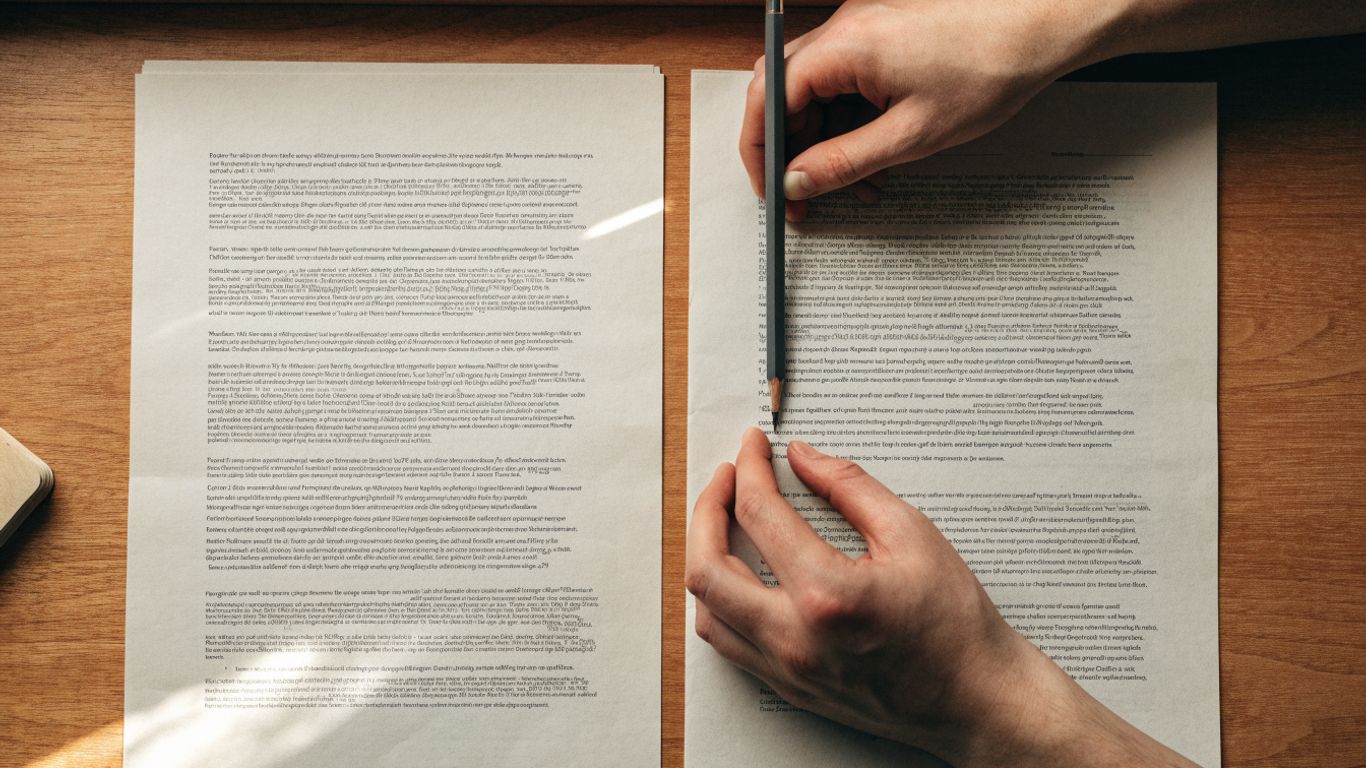
Align matching passages side by side
Place the passages next to each other and preserve enough surrounding text to understand their purpose. A sentence can look identical in isolation but function differently in context, such as when both essays quote or explain the same source. Compare sentence order, transitions, and nearby claims too. If you are working from paper copies, mark paragraph numbers so you can return to the same location.
Separate common phrasing from distinctive overlap
Not every matching phrase deserves equal weight. Terms required by the subject, familiar transitions, and wording drawn from an assigned prompt are less distinctive than an unusual analogy or a sequence of specific claims. As you annotate, separate the kinds of evidence that you’re seeing:
- Common terminology or standard definitions.
- Phrases that may come from the prompt or a shared source.
- Distinctive wording that appears in both essays.
- Similar sequences of claims, examples, or unusual details.
That quick sorting step helps you avoid treating every match as equally meaningful. It also makes your later explanation clearer: you can point to the particular overlap that prompted concern rather than relying on a vague impression.
Record similarities in a comparison table
A small table can keep your notes precise and make it easier to distinguish direct matches from broader similarities. Include enough context to locate each passage, and record a possible explanation when one is apparent. For example:
| What you notice | Essay A | Essay B | What to check |
|---|---|---|---|
| Exact phrase | Paragraph 2 | Paragraph 3 | Is it distinctive or source language? |
| Argument sequence | Claims 1–3 | Claims 1–3 | Does the prompt require this order? |
| Unusual detail | Shared error | Shared error | Does a common source contain it? |
Use the table to organize observations, not to generate a numerical verdict. Once the entries are visible together, you can weigh the pattern and revisit the context for each match.
Check whether paraphrased sections follow the same sequence
Copying concerns are not limited to identical sentences. Compare whether paraphrased passages preserve the same sequence of ideas, examples, and supporting details, particularly when both essays make the same unusual choices. A similar sequence may also reflect a shared source or outline, so check for those possibilities before interpreting it. Note what was changed and what stayed in the same order; that distinction is more useful than simply labeling a passage “similar.”
Use plagiarism-detection tools as supporting evidence
A tool can help you find passages worth reviewing, but its result is only one part of the picture. Different checks may search different material or compare text in different ways, so scores are not interchangeable proof. Use a report to guide a closer reading, then verify the matched text in the original essays. Keep the central question clear: what does the evidence show, and what does it leave unresolved?
Compare both essays in the same tool when possible
Using the same tool and settings can make the results easier to compare, though it does not remove the tool’s limitations. Confirm that both documents were processed successfully and that the report points to the actual passages you care about. If one essay contains citations or quoted source material, account for that before comparing totals. Consistent handling makes the review more orderly, not automatically more conclusive.
Review matched passages instead of relying on a score
A percentage can hide important differences: a report may count common phrases, references, or quoted material in ways that do not answer whether the essays were copied from each other. Open each match and check its context, source, and distinctiveness. GPTOne AI Text Detector analyzes writing for signals of AI authorship and provides confidence scores and reports; that addresses a different question from whether two essays share copied text. If you also need to assess that separate AI-authorship question, you can try the free detector, but it cannot establish copying between writers.
Understand what web-based checks can and cannot detect
A web-based check may identify overlap with material it can access, but a match between two private essays may not appear in public search results. A tool’s coverage, settings, and comparison sources affect what it can find. No score alone identifies who wrote first, whether collaboration occurred, or why the same wording appears. Treat the report as a way to locate possible evidence, then examine the documents and their history.
Protect student or unpublished work when uploading files
Before submitting an essay to any service, review its privacy terms and your school, workplace, or publisher’s rules. Unpublished research and student work may require particular care. If uploading is not appropriate, compare the texts locally or use a browser-based method that does not require an upload, where available. Keep a copy of the originals and avoid sharing more personal information than the review requires.
Consider other explanations for the similarities
Overlap can have more than one cause, so context matters as much as the matched words. Before you infer copying, check what constraints the writers shared: the prompt, course materials, research sources, and opportunities to collaborate. These factors can explain similarities without settling every concern. A fair review tests plausible explanations rather than starting from a fixed conclusion.
Check whether both essays use the same prompt or template
A narrow prompt may call for the same key terms, claims, or organizational structure from everyone in the class. Templates can also shape paragraph order and transitions. Compare the overlap with the assignment instructions: does the prompt prescribe the wording or sequence, or do the essays share details beyond what it requires? The more specific the overlap is beyond those constraints, the more carefully it may deserve review.
Look for shared sources that may explain matching language
Writers who consult the same source may repeat its terminology, examples, or even phrasing. Check whether the matching words appear in a cited reading, lecture handout, or other material available to both writers. Also consider whether quotation marks and citations are used consistently. If the source explains the overlap, that changes what the match can establish, even if citation practices still need separate attention.
Distinguish collaboration from direct copying
Students may discuss ideas, share notes, or work from a common outline where collaboration is allowed. That can produce similar arguments without showing that one person copied the other’s submitted text. Review the applicable rules and ask what kind of collaboration took place before making assumptions. The distinction matters: shared planning and direct reuse of another person’s sentences are not the same finding.
Consider whether common terminology makes overlap less meaningful
Some fields rely on fixed labels, standard definitions, or conventional ways to describe a method. A match built mostly from that language carries less information than the same unusual wording repeated across original analysis. Separate technical terms from the writers’ own choices, and judge the remaining overlap in context. The key is not how many words match, but how distinctive those words and their arrangement are.
Assess what the similarities can establish
A comparison can show that two essays share wording, structure, or details; it cannot automatically explain the relationship between them. To understand what the pattern supports, look for evidence about timing, authorship, and the writing process. Keep your conclusion narrower than your evidence. When the stakes are high, follow the relevant review procedure instead of trying to settle intent from a similarity score.
Identify which essay was written or submitted first
Submission records may help establish when each essay was received, but that is not always the same as when its text was written. A later submission does not by itself prove that its writer copied the earlier one, and an earlier file may have been revised after another person’s work was seen. Treat timing as one piece of context, not a shortcut to assigning responsibility.
Check drafts, version history, and timestamps if available
Drafts and version history can show how a piece developed and when changes were made. They may help explain whether a writer built the essay over time, but they do not necessarily establish where every idea or phrase came from. GPTOne AI Text Detector provides confidence scores and reports about signals of AI authorship; those signals are not evidence of which essay came first or who copied whom. Keep each kind of evidence tied to the question it can actually address.
Avoid assuming that matching text proves who copied whom
Matching passages can establish overlap, but direction and intent require more evidence. One writer might have copied from the other, both might have used a shared source, or the similarity might arise from an assignment constraint. Even convincing textual overlap does not tell you the full story without relevant context. State what you can verify and leave uncertain points open.
Treat automated reports as leads, not final judgments
Automated reports are useful for directing attention to possible matches. They can also miss overlap or flag material that has a reasonable explanation, depending on their coverage and settings. Read the source passages yourself, verify that the report represents them accurately, and compare the evidence with drafts or other records where appropriate. A human review is essential before any decision that could affect someone’s standing.
Document findings and choose a fair next step
Good documentation makes a review easier to verify and less likely to turn into a dispute about memory. Preserve the original materials, note exactly what prompted concern, and give the people involved a chance to explain relevant context. Your goal is a fair process, not a persuasive-sounding accusation. Keep observations separate from interpretations as you decide what to do next.
Save the original files and record where they came from
Keep untouched copies of both essays and record how and when you received them. If you make annotations or run a comparison, save that working copy separately from the originals. This helps you retrace your steps and reduces the chance that an edit or formatting change will be mistaken for part of the submitted work. Follow any rules that govern storing or sharing the files.
Note exact matches with page or paragraph references
Record the precise wording and the location in each essay, along with any relevant source or assignment material. Include enough surrounding text for another reviewer to understand why you flagged it. Avoid labels such as “copied” in your notes unless a formal review has reached that finding; neutral descriptions are easier to check. Clear references make the discussion more focused and fair.
Ask for context before making an accusation
A calm, open question gives the writer a chance to explain shared sources, permitted collaboration, or how the work developed. Describe the specific passage that needs clarification rather than making a broad claim about character or intent. Preserve the response as part of the record, and consider whether new information changes your interpretation. If you are a student responding to a concern about your own work, drafts and research notes can help document your process.
Follow the relevant school, workplace, or publication process
Different settings have different standards, privacy rules, and review procedures. Share your notes with the appropriate instructor, editor, or administrator rather than circulating an unverified allegation. If you need to assess a separate question about AI authorship, GPTOne AI Text Detector analyzes writing for AI-authorship signals and reports confidence scores; keep that evidence distinct from text-overlap findings. Choose the next step through the process that applies to your situation.
Conclusion
When you’re deciding how to tell if two essays were copied from each other, look for a pattern of distinctive overlap, test reasonable explanations, and document what you can verify. A careful comparison can clarify what deserves attention, but neither matching text nor an automated report tells the whole story. Keep your conclusions proportional to the evidence and give people a fair chance to respond.
Frequently Asked Questions
What similarities are most suspicious between two essays?
Several distinctive phrases appearing in the same order, especially alongside unusual shared examples or errors, merit closer review. Common terms or wording required by the prompt are less informative on their own.
Does a high similarity score prove that one essay was copied?
No. A score can point to text worth checking, but it does not establish why the overlap exists, who wrote first, or whether copying occurred. Review the matching passages and their context.
Can two essays be similar without either writer copying the other?
Yes. A shared prompt, template, source, or permitted collaboration can lead to overlap. Check the assignment requirements and available materials before drawing a conclusion.
How can I compare two essays fairly?
Align the relevant passages, note exact matches and their locations, and distinguish common terminology from unusual overlap. Keep the original files and record possible explanations as well as concerns.
Do plagiarism checkers find matches between private essays?
Not necessarily. A web-based check may search accessible material and may not have access to two private submissions. Its coverage and comparison sources affect what it can identify.
Can matching text show which writer copied first?
Matching text alone cannot establish direction. Submission dates, drafts, version history, and other records may add context, but each has limits and should be reviewed together.
What should you do before accusing someone of copying?
Preserve the essays, document the specific passages, check plausible explanations, and ask for context without assuming intent. Then follow the applicable school, workplace, or publication process.