How to Compare Two Student Essays for Similarity (Free, No Upload)
 Sana Bano
·October 7, 2026
·12 min read
Sana Bano
·October 7, 2026
·12 min read

Learn to compare two student essays for similarity privately, review meaningful matches, and interpret results fairly.
Key Takeaways
A careful comparison can help you decide what deserves a closer look, but matching text alone cannot explain why two essays are alike. Keep the process private, specific, and fair to both students.
- Start with complete, comparable versions of both essays.
- Separate common course language from distinctive similarities.
- Use an offline comparison method when privacy calls for it.
- Treat matching text as a reason to review, not proof of misconduct.
- Record evidence and give each student a fair chance to respond.
Prepare the essays for a fair comparison
Before you compare two student essays for similarity, make sure you are working with versions that can be judged on the same basis. Small differences in what you include—such as an assignment prompt or bibliography—can change what looks like a match. A few minutes of preparation can prevent a distracting or unfair result.
Use complete, comparable versions of both essays
Work from the full submitted essays, not excerpts selected because they already seem alike. Check that both files include the same kinds of material and that one is not an early draft while the other is a final submission. If students were responding to a comparison assignment, a guide to comparison and contrast planning may help you distinguish shared requirements from choices each writer made.
Remove names and other identifying details
If you are using a tool or sharing notes with a reviewer, remove student names, ID numbers, and other personal details first. Replace names with neutral labels such as Essay A and Essay B, and check headers, file names, comments, and document properties for identifying information. Anonymizing the working copies can help keep attention on the writing itself.
Decide whether to include quotations, references, and assignment prompts
Set a consistent rule for material that may be shared by design. A required prompt, a class reading title, or a correctly quoted source can appear in both essays without indicating that students copied from one another. A simple inclusion guide keeps those elements from skewing your review:
| Material | Include in the comparison? | What to keep in mind |
|---|---|---|
| Main essay text | Yes | Compare the same sections in both essays. |
| Assignment prompt | Usually exclude | Shared wording may come directly from the instructions. |
| Direct quotations | Review separately | Check the source and quotation marks. |
| References or bibliography | Often exclude initially | Required sources can naturally overlap. |
After the first pass, you can review excluded material separately if a specific question remains. Consistency matters more than choosing one universal rule for every assignment.
Keep the originals unchanged for later review
Save the original submissions as they were received, and make separate copies for anonymizing or formatting. That gives you a reliable record if a student asks what material was reviewed or if you need to revisit a passage later. Avoid editing the originals to make the texts easier to compare.
Compare two student essays for similarity without uploading them
You can start with a careful human read, then use a local comparison method to locate passages worth reviewing more closely. The goal is not to produce a verdict from a matching percentage; it is to find the particular wording or structure that needs context. GPTOne’s Diff Checker is one browser-based option for comparing two texts online without signup or uploads, while offline tools may be preferable when your school requires local processing.
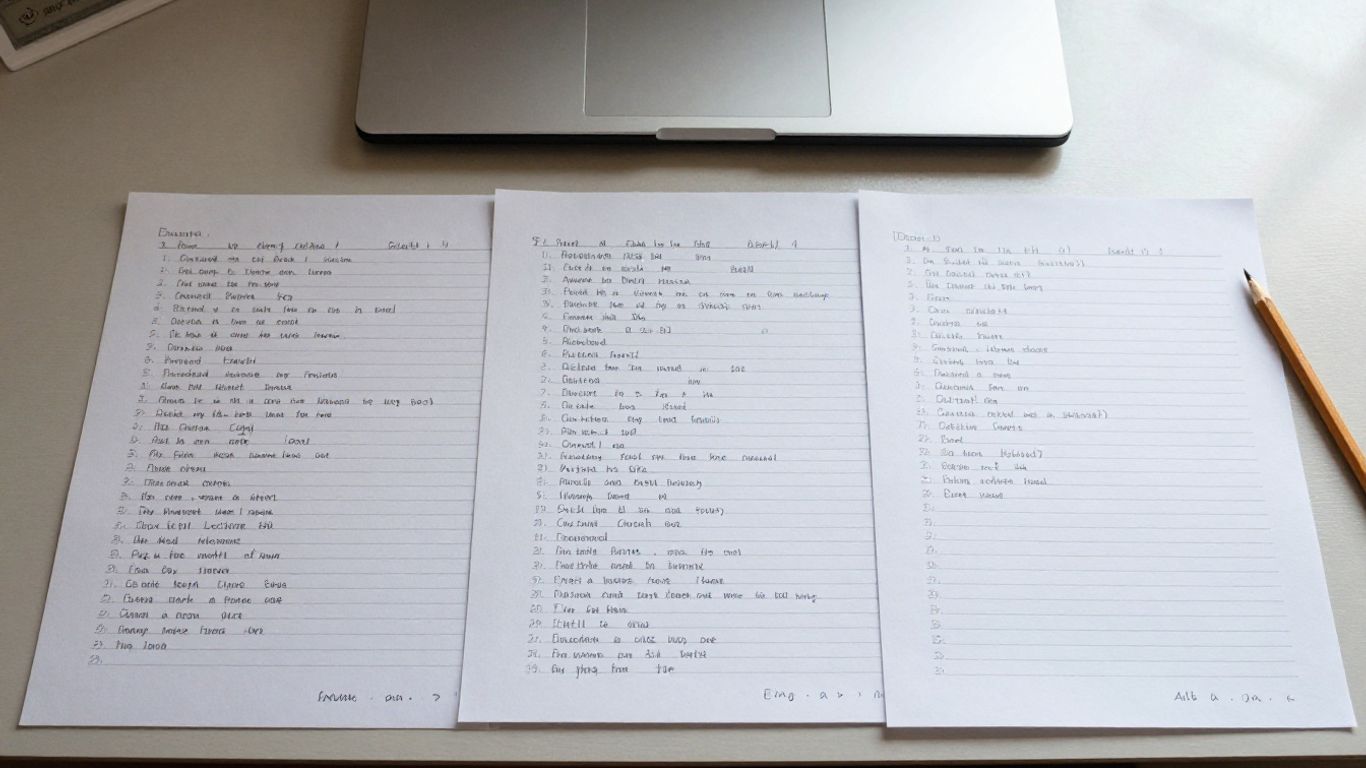
Read both essays side by side to spot shared ideas and wording
Read a paragraph from one essay, then the corresponding section in the other. Note where the students make the same point, but also ask whether they develop it in the same way or support it with different reasoning. A side-by-side read often reveals that a broad overlap comes from the prompt, while a more unusual phrase or example calls for closer attention.
Check repeated phrases, sentence patterns, and paragraph structure
Look beyond exact word matches. Two essays may share an unusual phrase, follow the same sequence of claims, or use similar transitions and examples. GPTOne’s Diff Checker can show text changes such as added, removed, rewritten, or moved passages; its comparison can help you locate areas to read, not determine why they match. You can also review a free text comparison when an online, no-upload option fits your privacy requirements.
Use an offline word processor’s document comparison feature
If your word processor offers document comparison, use it on copies of the essays and read the marked changes in context. Review the program’s settings first: formatting changes, comments, or headers can create noise that has little to do with the students’ writing. A document comparison is most useful when it narrows your attention to passages you can assess yourself.
Try a local text-diff tool and confirm it works without internet access
A local text-diff tool can compare two files on your device, but do not assume that a tool is offline just because it looks like an app. Disconnect from the internet and test it with non-sensitive sample text before using student work. Confirm that the files stay local, and check the result against the original documents so that line breaks or formatting do not mislead you.
Review the kinds of similarities that matter
Not every overlap carries the same weight. Shared terminology and a familiar essay structure may be expected; a distinctive sequence of ideas or an unusual shared mistake may deserve another look. Consider how the assignment shaped both papers before drawing conclusions from any one feature.
Separate common phrases from distinctive wording
Common academic transitions and required vocabulary are weak evidence on their own. A phrase that is unusually specific, repeated in the same place, or paired with the same uncommon example may be more informative. Treat distinctive wording as a reason to examine context, not a conclusion about how the text was produced.
Compare the development and order of ideas
Ask whether the students merely address the same topic or whether they make the same points in the same order, with similar supporting details. Compare how each writer moves from claim to evidence and explanation. Similar organization can be a product of a shared rubric, so consider the assignment before deciding how notable the pattern is.
Look for matching errors, unusual examples, or source choices
A repeated typo or an unusual example can be more revealing than a run of common words, especially when it appears alongside other specific parallels. Check whether both essays cite the same source in a similar way, and whether that source was assigned or widely used. No single feature settles the question, but several independent details can clarify what you should ask next.
Account for shared prompts, class materials, and required terminology
Students working from the same readings, lecture notes, and rubric will naturally share some language and concepts. Note any terms the course required and any examples discussed in class. With those influences in view, you can focus on similarities that reflect individual writing choices rather than the common ground of the assignment.
Interpret the results carefully
A comparison marks resemblance; it does not reveal intent or establish who wrote a passage first. Read every flagged section in full and consider how the writing fits the assignment and the students’ circumstances. If you use an automated score, treat it as a rough pointer to material for human review.
Treat matching text as a signal for review, not proof of misconduct
A match is a prompt to ask questions, not a finding by itself. Similarity can arise from shared sources, required wording, collaborative work, or ordinary overlap in how people explain a subject. If you are reviewing a separate question about possible AI authorship, check AI writing as a distinct issue; that signal does not establish copying between two students.
Check whether citations and quotation marks are used appropriately
When the same words appear in both essays, check whether they are quoted and attributed to the same source. A shared quotation may be legitimate if students were assigned the same reading, though citation mistakes still deserve feedback. Distinguish between overlap in sourced material and matching original analysis.
Consider legitimate explanations for similarities
Students may have studied together, used the same class notes, or independently relied on the same source. They might also have followed a highly structured prompt that led them through the same sequence. Ask what explanation fits the specific passages instead of assuming that one cause applies to every similarity.
Avoid relying on a single score or automated judgment
A percentage compresses many different kinds of overlap into one number. It may count common phrases or miss a meaningful similarity in structure, so inspect the matched passages and compare them with the assignment. A score can help you decide where to look; it cannot replace a fair review of the evidence.
Protect privacy while comparing essays
Student writing can contain personal experiences, identifying details, and unpublished work. Before choosing a method, find out what happens to the text when it is opened or processed. If you cannot tell where it goes or how long it is retained, use a different approach.
Check where a tool processes and stores text
Read the tool’s privacy information before entering student work. Find out whether text is processed on your device or sent elsewhere, whether it is retained, and whether it may be used for another purpose. “Free” does not answer those questions; check the actual terms and your school’s rules.
Prefer offline methods for sensitive student work
For confidential essays, a local word processor or verified offline diff tool may be a better fit. Confirm that the feature does not require an online account or send text to a server, and follow any institutional requirements for student records. GPTOne’s Diff Checker is described as comparing two texts online without signup or uploads, but an online workflow is not the same as an offline one; choose according to your privacy needs.
Avoid pasting essays into public websites or AI chat tools
Do not paste student writing into a public website or an AI chat simply because it is convenient. You may not know how the service handles the text, and the assignment may contain sensitive material. Use only tools approved for the work and permitted by school policy.
Delete temporary comparison files when they are no longer needed
Remove working copies, exports, and temporary notes when your review is complete, subject to your school’s record-retention rules. Keep only what policy requires, and store those records securely. A tidy process reduces unnecessary exposure without erasing documentation you are obligated to retain.
Document findings and choose a fair next step
If similarities warrant follow-up, make your notes specific enough that another person can understand what you observed. Avoid labels or conclusions that go beyond the evidence. A clear record makes it easier to apply the same process consistently and to give students a meaningful opportunity to respond.
Record specific passages and similarities for follow-up
Note the page or paragraph, the matching words or structure, and relevant context such as a shared reading or prompt. Keep a copy of the comparison view only if school policy permits it, and make sure your notes distinguish direct matches from your interpretation. This is more useful than saving a score without the passages behind it.
Give each student a chance to explain their writing process
Ask neutral, open questions about how the students planned, researched, and drafted their essays. They may be able to describe the source of a phrase or show drafts and notes that clarify their process. Give each person a chance to respond before deciding what the similarities mean.
Follow school policies and apply them consistently
Check your institution’s procedures for reviewing writing, contacting students, and escalating a concern. Apply the same standards to both essays and to comparable cases. If the policy requires another reviewer or a formal process, follow it rather than making an informal judgment alone.
Use the review to guide feedback and support learning
A comparison can reveal a teaching need even when it does not support a misconduct concern. You might clarify citation practices, explain how collaboration should be acknowledged, or help students develop more independent analysis. The fairest next step is the one that fits the evidence and supports learning.
Conclusion
To compare two student essays for similarity fairly, prepare equivalent copies, examine the specific overlaps, and keep the limits of any score in view. If you want a separate signal about possible AI authorship, try the GPTOne AI detector, then interpret its results as evidence for human review—not proof of who wrote a paper.
Frequently Asked Questions
Can two essays be similar without one student copying the other?
Yes. Shared prompts, assigned sources, class notes, and required terminology can lead to overlap, and students may reach similar ideas independently. Consider the particular wording and context before deciding what a match means.
What should I compare first?
Start with the complete main text of both essays, using comparable versions. Read corresponding sections side by side, then note distinctive wording, examples, or sequences of ideas that merit a closer look.
Should I include citations and references in a comparison?
You can review them, but it is often useful to begin with the main essay text and consider citations separately. Students assigned the same sources may have overlapping references, so check whether the cited material was required.
Does a high similarity percentage prove plagiarism?
No. A percentage only summarizes matches according to a tool’s method. It does not explain their cause, and it should not replace a contextual review of the passages or the school’s process.
How can I compare essays without uploading them?
Use a word processor’s document comparison feature or a local text-diff tool that you have verified works offline. Test it with non-sensitive text first and check that it does not send files elsewhere.
Should I remove student names before comparing essays?
Yes, when practical, remove names and other identifying details from working copies, including file names and comments. Keep the untouched originals separately and follow your school’s privacy and recordkeeping rules.
What should I do if I find several unusual matches?
Record the exact passages and their context, then follow school policy and give each student a chance to explain their writing process. Avoid deciding what happened from the similarities alone.