How Accurate Are AI Image Detectors? We Tested 60 Images
 Sana Bano
·August 12, 2026
·8 min read
Sana Bano
·August 12, 2026
·8 min read
How accurate are AI image detectors? We ran a 60-image benchmark across 5 categories. Here is what real testing shows and how to read the results honestly.
AI image detectors are accurate enough to be genuinely useful, but only when they are built and tested properly, and no honest tool should claim a single perfect number. To see how GPTOne's AI image detector actually performs, we did not just assert a figure. We ran a hands-on benchmark of 60 images across 5 categories, mixing AI-generated and real photos, and documented the whole method. Here is what real testing shows, and how to read any detector's accuracy claim without getting fooled.
Key Takeaways
- Detector quality varies widely: one 2024 study found three tools scoring 75%, 53%, and 56% on the same set.
- We tested GPTOne on a 60-image benchmark across 5 categories, mixing AI and real photos.
- The metric that matters most is the false-positive rate, not the headline detection number.
- For images, GPTOne reports a confidence score plus a heatmap, not one fixed accuracy percentage.
- Compression and editing lower accuracy, so real-world results differ from clean lab tests.
Why "how accurate" has no single answer
Accuracy is not one number, and any tool that gives you just one is oversimplifying. A detector can score 98% on a clean set of lab images and then stumble on a compressed screenshot from a chat app. The image itself, its quality, and its history all move the result.
According to our benchmark write-up, and this is the honest core of it, a real test needs enough images across enough categories to mean anything. As we put it, "a benchmark needs 60 images minimum across 5 categories to produce numbers you can defend." One or two cherry-picked examples prove nothing, which is exactly why so many marketing accuracy claims are meaningless.
How we tested GPTOne
We built a structured benchmark rather than eyeballing a few images. Sixty images, spread across five categories, mixing AI-generated pictures with real photographs so we could measure both catching fakes and, just as important, not flagging real photos. The full method and results are in our AI image detector benchmark, published as our own hands-on testing.
Here is one concrete result from that testing. We fed GPTOne a photoreal AI-generated portrait, the kind that passes a quick human glance, and it flagged the image as AI Generated at 97% confidence, with a High confidence badge.
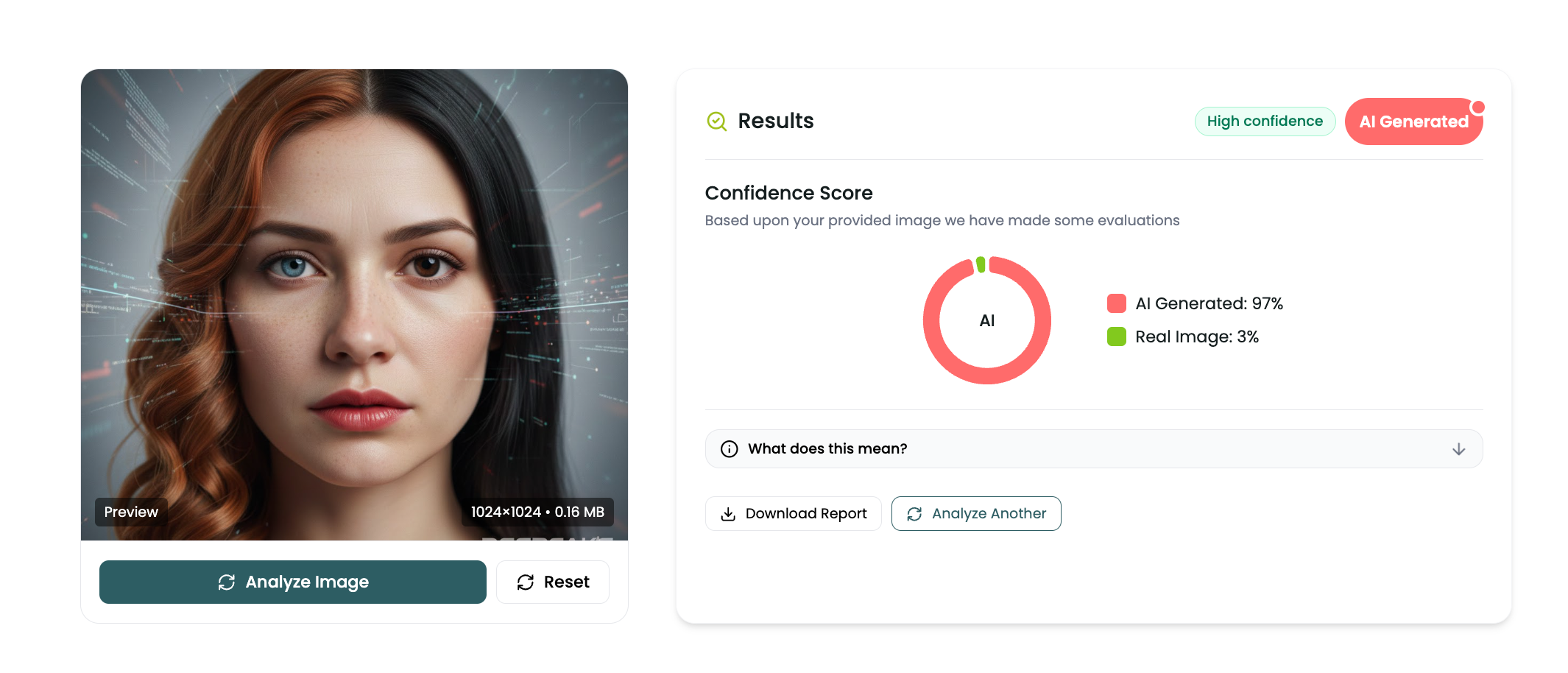
That is the kind of result you want to see: a clear, high-confidence call on a genuinely hard image, with a score you can weigh rather than a black-box verdict.
The metric that actually matters: false positives
Most accuracy debates focus on the wrong number. Catching AI images is only half the job. The half that hurts people is the false positive, when a real photo gets wrongly flagged as AI. That is the error that damages a real photographer, an honest seller, or a genuine news image.
As we wrote in the benchmark, "false positives are the error that matters." A tool that brags about a high detection rate but quietly flags real photos is not accurate in any way you should trust. We built GPTOne to keep that false-positive rate low, which is why we test on real images alongside AI ones rather than only measuring how many fakes it catches. We go deeper on the concept in do AI image detectors actually work.
Why we report confidence, not one accuracy number
You will notice GPTOne does not stamp a single accuracy percentage on the image tool. That is deliberate and honest. On text, GPTOne is a 99.99% accurate detector across major models, because text detection is a more stable problem. Images are messier, so for pictures we give you a confidence score plus a heatmap and let you read the evidence.
A per-image confidence score tells you how sure the tool is about the specific image in front of you, which is the thing you actually care about. A single blanket accuracy figure would hide the uncertainty that compression and editing really introduce. We break down how to read the number in what an AI image confidence score means.
How to judge any detector's accuracy claim
When a tool advertises an accuracy number, ask four questions. How many images was it tested on, and were they varied or cherry-picked? Did the test include real photos, or only AI images, so you can see the false-positive rate? Were the images realistic quality, or pristine lab samples? And is the test reproducible, or just a claim?
A tool that answers those honestly is one you can trust. A tool that just flashes "99% accurate" with no method behind it is selling, not testing. That is the whole reason we published our method openly, so you can check the logic rather than take a number on faith. For a head-to-head view, see the best AI image detection tools tested.
What lowers real-world accuracy
Lab numbers and real life diverge for a few concrete reasons, and knowing them helps you read a result. Heavy compression from social platforms smooths away the fine artifacts detectors rely on. Screenshots and re-saves each strip detail and metadata. Small or low-resolution images give the tool less to work with. And brand-new generators can outrun older detectors until they are retrained.
So the honest expectation is a strong signal, not a guarantee. Upload the highest-quality version of a file you have, read the confidence score with the heatmap, and confirm anything important with provenance like C2PA Content Credentials or a SynthID watermark when they survive.
Text accuracy is a different, steadier story
It is worth separating the two problems, because people lump them together. Detecting AI text is a more stable task than detecting AI images, which is why GPTOne's free AI text detector can stand behind a 99.99% accuracy figure across ChatGPT, Claude, Gemini, and more, while the image tool deliberately reports a confidence score instead.
The difference is in how the two kinds of content degrade. Text keeps its statistical fingerprint through copying and reformatting, so a detector sees a clean signal. Images lose their fingerprint to compression, cropping, and re-saving, so the same fixed-number approach would overpromise. Holding two different honesty standards for two different problems is not a hedge; it is what accurate reporting actually requires. If a vendor gives you one big number for images with no method, that is the tell they are marketing rather than measuring.
The honest bottom line
AI image detectors work, the good ones well, but accuracy is a range, not a badge. Judge a tool by whether it tests on real photos, keeps false positives low, shows you where the AI signal is, and publishes its method. By those standards, our testing is open for you to check, and the tool gives you a confidence score plus a heatmap instead of a number you have to trust blindly. That is what accountable accuracy looks like.
The practical takeaway is simple. Trust a detector that shows its work, and be wary of one that only shows a slogan. Then use it the right way: as a fast, strong first read that you confirm with the heatmap, the visual tells, and provenance when the stakes are real.
FAQ
How accurate are AI image detectors?
The good ones are strong but not perfect, and quality varies a lot between tools. Accuracy depends on image quality, compression, and the generator, so judge a detector by its testing and its false-positive rate, not a single advertised number.
Did you really test GPTOne?
Yes. We ran a hands-on benchmark of 60 images across 5 categories, mixing AI and real photos, and published the method. One example: it flagged a photoreal AI portrait as AI Generated at 97% confidence.
Why does GPTOne not show one accuracy percentage for images?
Because compression and editing shift the signal so much that one number would mislead you. A confidence score plus a heatmap is more honest, telling you how sure the tool is about your specific image and where the evidence is.
What is the most important accuracy metric?
The false-positive rate, how often a real photo is wrongly flagged as AI. A high detection rate means little if the tool also flags genuine photos, so we test on real images too.
Is the detector free to try?
Yes. GPTOne's image detector is free to try on signup credits. Upload a JPG, PNG, or WebP and get a confidence score and heatmap in seconds.
Try the free AI image detector at gptone.me.